Multilevel brain and behavior mapping reveals how early adversity drives distinct neurobiological and behavioral paths depending on sex
Key Messages:
- Early life adversity is an established risk factor for psychiatric illnesses such as depression and anxiety, disorders that display significant sex differences in prevalence, clinical symptoms, and treatment response.
- A translational mouse model combining prenatal and early postnatal stress (PNELS) demonstrated that early adversity lead to social subordination in both sexes, but induced patterns in behavioral flexibility, reaction to rewards and impulsivity that differed significantly between males and females.
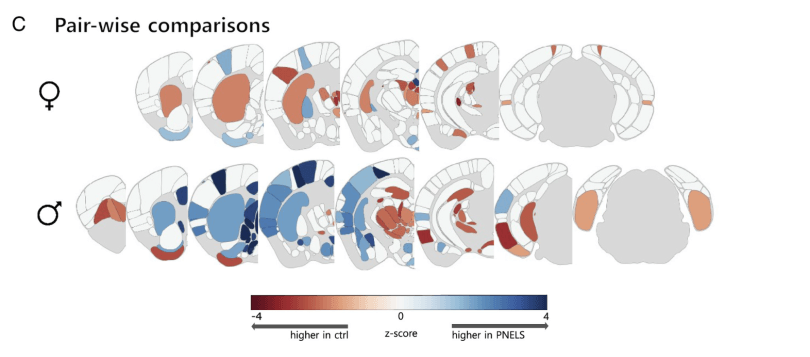
- Whole-brain mapping revealed that early adversity triggered opposite functional signatures between sexes, including hyperactivation and reduced circuit connectivity in males versus hypoactivation and heightened connectivity in females.
- Early stress shapes the brains of males and females in completely separate ways. This challenges the previous male-centric view on stress psychopathology and paves the way for future sex-specific biomarkers and treatments.
Exposure to stress during critical developmental windows significantly increases the risk of developing mood and anxiety disorders in adulthood. While women and sexual- and gender-minority groups experience higher rates of adversity and stress-related disorders, the underlying biological mechanisms driving these sex-influenced vulnerabilities remain poorly understood. In a recently published study, the research team co-led by Mathias Schmidt and Elisabeth Binder from the Max Planck Institute of Psychiatry in Munich, together with international collaborators from the Douglas Research Centre at McGill University in Montréal and the Université Côte d’Azur, provides a comprehensive, multilevel characterization of how developmental stress reshapes adult brain function and behavior.
AI-powered phenotyping reveals distinct behavioral profiles based on sex
To capture the chronic adversity experienced by humans, the researchers studied mice exposed to stress during both pregnancy and early life. Using AI-guided video tracking and machine learning, the team mapped subtle behavioral patterns that standard tests often miss. While early life stress pushed both male and female mice into lower social ranks, it triggered strikingly different patterns in everyday behavior: Stressed males lost behavioral flexibility, defaulting to rigid, repetitive movement habits, and showed classic depression-like signs, including a loss of interest in sweet rewards and heightened nighttime impulsivity. Stressed females, by contrast, preserved their behavioral flexibility and consumed more sweet treats than unstressed controls, highlighting a fundamental sex difference in reward sensitivity.
Brain imaging and genetics reveal opposite biological pathways
To understand the biology driving these behaviors, the researchers tracked brain activity and gene expression across the entire brain. Long-term MRI brain scans showed that activity across major stress- and emotion-processing hubs shifted in opposite directions: it increased in stressed males but decreased in stressed females. When facing a brief social encounter, whole-brain cellular mapping revealed that male brains went into overdrive while losing coordinated communication between brain regions. Female brains displayed the opposite response, showing lower cellular activation alongside stronger, denser network connections. At the molecular level, gene sequencing across ten brain regions identified key reward and anxiety centers – specifically the nucleus accumbens and the bed nucleus of the stria terminalis – as major hubs of sex-specific rewiring. Early adversity activated genes related to cellular energy and metabolism in males, while triggering pathways linked to brain plasticity and wiring in females. Crucially, when comparing these results with postmortem brain data from humans with major depressive disorder, the team found matching, sex-opposite genetic patterns in the same brain regions. These findings demonstrate that early trauma reshapes male and female brains through distinct biological routes, underscoring the necessity of sex-informed approaches when developing psychiatric treatments.
Perspectives on targeted psychiatric interventions
“In this study, we were able to uncover how profoundly sex shapes the lasting impact of early life adversity across multiple levels of brain organization,” says Sowmya Narayan, first author of the study. “Our findings show that developmental stress engages different neural circuits and molecular pathways in males and females.”
“This work challenges classical, male-centric interpretations of stress-related psychopathology,” explain senior co-leads Mathias Schmidt and Elisabeth Binder. “Recognizing that early trauma primes male and female brains through distinct, and often opposing, biological trajectories provides a foundational resource for human comparisons and paves the way for sex-informed biomarkers and more precise, equitable therapeutic strategies.”
Original Research can be found here.
Source: Max Planck Institute of Psychiatry
Original article: http://www.psych.mpg.de/2992025/news_publication_26976154_transferred?c=1496360
 Max Planck Institute of Psychiatry